

In food production environments, insect contamination poses a significant threat to product safety and quality. According to GMP standards and HACCP system requirements, it is essential for food-grade factories to establish comprehensive insect prevention systems. As the junction point between the factory and the external environment, the design and configuration of factory doors are particularly important. This article will share several effective strategies for preventing insects at food-grade factory doors, helping you create a pest-free clean production environment.
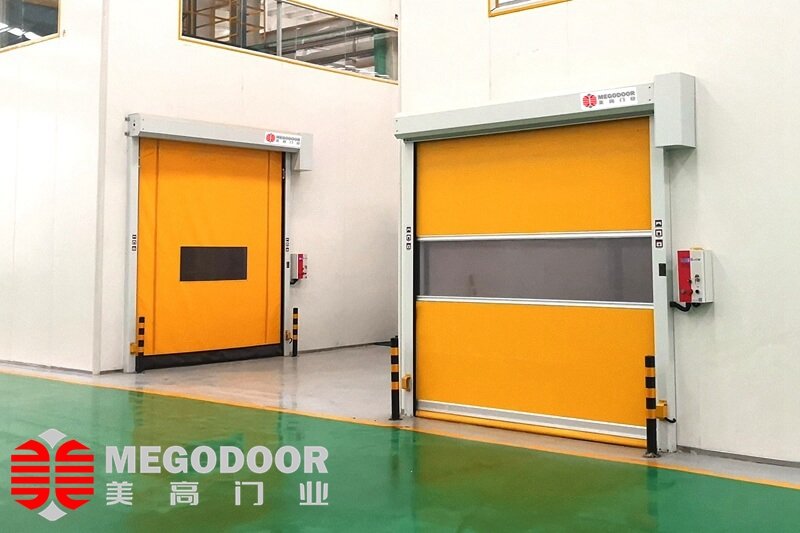
1. High-Speed Roller Shutters: The First Line of Physical Defense
High-speed roller shutters are fundamental configurations for insect prevention in food factories. With opening and closing speeds reaching 0.8-2.0 meters per second, they significantly reduce the time that doorways remain open, effectively minimizing opportunities for insect entry. High-quality food-grade roller shutters use food-grade PVC materials with smooth, seamless surfaces that do not harbor dirt or grime and feature self-repair capabilities, automatically resetting after accidental collisions with forklifts to ensure continuous protection. It is recommended to consider models with transparent windows for easier observation of conditions outside, thus avoiding frequent door openings.
2. Interlocking Double Doors: Creating Buffer Zones
In critical areas such as raw material entrances and finished goods exits, interlocking double doors can create an airlock effect. When the first door opens, the second one automatically locks and vice versa, ensuring both doors never open simultaneously. This design is especially practical for logistics passages, meeting material handling needs while preventing insects from entering. Depending on the available space, buffer zones can be designed as straight-through or corner-shaped, with a suggested area of no less than 4 square meters to provide sufficient room for personnel and material movement.
3. Air Curtains: Invisible Protective Barriers
Installing air curtains at major factory entrances creates an invisible barrier of air. High-performance air curtains should have outlet wind speeds reaching 7-9 m/s, covering the entire width of the doorway to form a continuous airflow curtain. Studies show that properly configured air curtains can block over 85% of flying insects. Recommended installation height is 2.2-2.5 meters above ground level with a tilt angle of 15-20 degrees to ensure airflow covers the bottom of the doorway without leaving any unprotected corners. Choosing food-grade stainless steel air curtains facilitates cleaning and disinfection, complying with food safety production requirements.
4. Yellow Door Curtains: Visual Insect Deterrent
Research indicates that insects have lower sensitivity to yellow light waves but are more active in blue and ultraviolet regions. Thus, installing yellow transparent door curtains in auxiliary passages or small doors frequently used by personnel serves as an economical and practical insect prevention measure. Besides physical obstruction, the specific color also reduces the likelihood of insects approaching. It is advised to select food-grade PVC materials with a thickness of 1.5-2.0 mm, regularly replacing them to maintain cleanliness and prevent surface stains from diminishing their effectiveness.
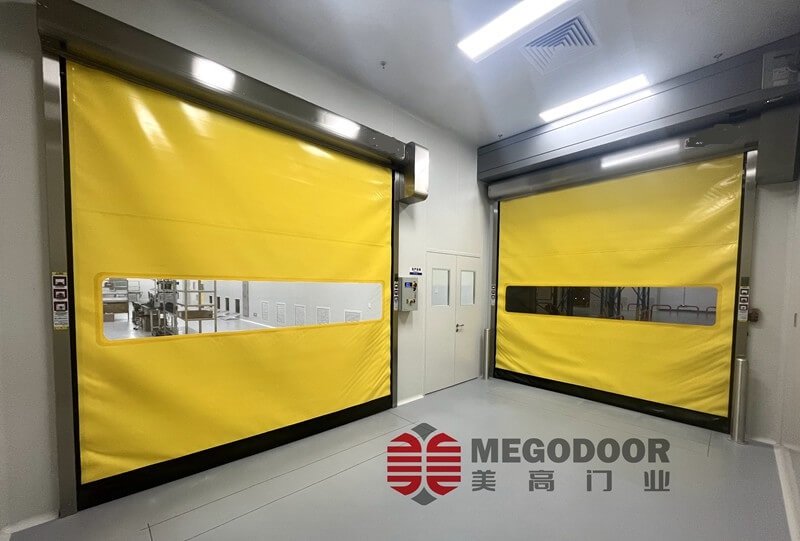
5. Smart Coordination Between Air Curtains and High-Speed Doors
Integrating air curtains with high-speed roller shutters can achieve more efficient protection. When sensors detect someone or something approaching, the system activates the air curtain 1-2 seconds beforehand to establish an airflow barrier; when the door opens, the air curtain operates at full capacity; after the door closes, the air curtain delays shutting off for 3-5 seconds to ensure residual airflow disperses any lingering insects. Such integrated systems require professional PLC control, suggesting professional teams handle design and installation to ensure all devices work harmoniously, achieving a 1+1>2 protective effect.
6. Installation of Fly Traps Near Entrances: The Final Barrier
Professional food-grade fly traps should be installed 1.5-2 meters inside all exterior doors as supplementary protection. Opt for LED UV light sources to avoid food safety risks associated with traditional mercury lamps breaking; install at a height of 1.8-2.0 meters, away from pedestrian and logistics paths to prevent interference and collisions; clean collection trays weekly and replace bulbs monthly to maintain optimal performance. Pay special attention to positioning fly traps away from direct contact with food products, ideally in buffer zones or transitional non-clean areas, to prevent dead insects from falling into product areas.
System Integration: Comprehensive Insect Prevention Solutions
Single insect prevention measures have limited effects. It’s recommended to adopt systematic designs based on factory layouts and functional areas. For example, raw material entrances could implement “double door interlocks + air curtain integration + fly traps” triple protection; personnel passages may configure “high-speed roller shutters + yellow door curtains + overhead air curtains”; whereas logistics gates suit “smart coordination between high-speed roller shutters and air curtains + dual-side fly traps”.
Moreover, insect prevention systems must be coupled with daily management practices: establishing access control policies to limit unnecessary door openings; conducting regular pest monitoring to assess protection effectiveness; training staff to develop habits of closing doors immediately; and performing monthly maintenance on insect prevention equipment. Only through combining hardware facilities with soft management can a truly effective insect prevention system for food-grade factories be built, ensuring product quality and consumer safety.
In today’s increasingly health-conscious society, scientifically sound insect prevention systems are not only compliance requirements but also concrete demonstrations of a company’s commitment to quality. By reasonably configuring professional equipment like high-speed roller shutters, double door interlocks, air curtains, yellow door curtains, and achieving intelligent coordination, food production enterprises can effectively block insect contamination routes, providing safer and healthier products for consumers.